Showing posts with label advertising. Show all posts

Friday, January 21, 2022

"The green M&M, previously seen in ads posing seductively and strutting her stuff in white go-go boots, will now sport a pair of sneakers."

"A description for the green candy on the M&M’s website says she enjoys 'being a hypewoman for my friends.' 'I think we all win when we see more women in leading roles, so I’m happy to take on the part of supportive friend when they succeed,' the green M&M said on the promotional site." 

From "M&Ms characters to become more inclusive" (The Hill).

I didn't know that M&Ms had become color-based characters. If you're green, you're one thing, red, another...? Is that a good lesson for the kids?

I feel so old, only able to remember an M&Ms advertisement that's half a century old — you know, the one where the peanut M&M and the regular M&M are sunning by a pool. The emphasis back then was that kids made a mess out of chocolate that's not "candy-coated." They did add arms, legs, and faces to the M&M, so they were, essentially, characters, but I don't think we expected them to have individualized personalities. Or was the peanut M&M a bit "nutty"?

What is the history of adding arms and legs to food items for advertising? Was the Kool-Aid Man first — in 1954? Oh, no, wait! Mr. Peanut has him beaten. 1916. And Mr. Peanut always had a lot of personality: He was high-class and cheerful. And what about the California raisins? You don't see them around anymore. Their time came and went — 1986 to 1994.

But back to the green M&M, which I've never seen in action. It's hard to believe the ad makers styled it as some sort of "seductive" go-go dancer, but if that happened, improvement was needed. It's funny that they went for the most flat-footed feminist concept. If you're such an achiever, Green, why are you eating candy?!

Finally, let me say that I have never before seen the word "hypewoman." I read that as "hyperwoman" first, and that sounded candy-appropriate. But "hypewoman" — that looks like it should mean huckster or con artist. Urban Dictionary tells me it's the female version of "hypeman" — someone who comes out on stage to hype up the audience before a performer comes out and may "work the side of the stage... yelling classic lines like 'Throw ya hands in the air!' 'All the ugly people be quiet!' 'When I say_________, y’all say _________!'"

And that undoes my impression that they just made Green a feminist cliché. She's actually a bit of a sexist stereotype, taking the role of supporting others. Re-experience that Françoise Gilot quote that begins the previous post:

"As young women... were taught early that taking second place is easier than first. You tell yourself that’s all right, but it’s not all right. It is important that we learn to express ourselves, to say what it is that we like, that we want."

The new green M&M is not all right. Whenever they change something that's wrong, they just change it to something else that's wrong. Wrong in a new way.

Wednesday, January 13, 2021

Why I put AdSense ads back on the blog — self-defense.

Last October, after years of taking offense at Google for sending me email telling me I had offensive material on this blog, I discontinued my participation in Google Adsense. That is, I opted out of using advertising to monetize this blog. At the time, I wrote: 
I'm tired of checking to see what's supposedly a violation. I get so many of these and they're often posts that are nothing but a quote from a commentator in the NYT. But to see that the review didn't okay these pages... it's just mind-bending. I can't waste my energy dealing with this bullshit. In every case, I'm told that I've violated their policy with "Dangerous or derogatory content," which I find insulting. Here are recent posts that have been found in violation of that policy — even after review... 
Click through to see what I'd written, but suffice it to say that there was nothing that could possibly be considered "dangerous" or "derogatory." I said:
How did these articles get flagged? By robots or by opponents of this blog? What kind of review does Google have that would reinforce the idea that this is "Dangerous or derogatory content"?! Review by robots or by opponents of this blog? I can't imagine an unbiased human being finding all — or any — of these posts to have "Dangerous or derogatory content." It could be that I'm getting flagged for crap in the comments.... 

I'm not dealing with it any more. So enjoy ad-free Althouse.

Well, I am going to deal with it now and in the future.  I just turned AdSense ads back on. At least, Google was nice enough to offer me cake....

... yeah, Google, your AI did a nice job of knowing what I like. Cake. I like cake. But it's not yummy cake that has me coming back. And it's not the income from the ads. I realized I can use AdSense in self-defense. Google has the power to delete this blog. Whatever force caused those exasperating notifications is still out there, exerting pressure, whether I'm getting notifications or not.

As I noted in that October post, "It could be that I'm getting flagged for crap in the comments." In the comments there, Yancey Ward said: 

It isn't your content that is getting flagged, Ms. Althouse, it is what we commenters are saying - they are flagging the separate blog post which contains all of the comments at the end. You just have too many of us deplorables.

I'm pretty sure that's what happened, and I gave up ads because it seemed like too much work to go searching for what might be the problem in the comments. But the mechanism for reporting abuse to Google remains. This presents a risk to me, and I think the risk has increased in the past week. So I want those notifications. I'm worried not only that Google will overdo its censorship but also that haters of this blog — of the comments section of this blog — will come in here with pseudonyms and write violent threats and racist crap for the purpose of drawing censorship down upon me. 

There are various ways to deal with the problem of commenters who are here to hurt me, and some of them are too labor intensive. Some of them would diminish (or destroy) the flow of the comments. The comments at their best are phenomenal, and I'm very happy with the good commenters and have greatly appreciated their company these last 17 years. (Bloggiversary #17 is tomorrow.) But one thing I can do is to put the ads back up and then use the notifications to identify the comment threads that have something Google sees as a problem. Then it's a limited task to look for what needs to be deleted.

I delete comments without prodding from Google when I see threats of violence. I delete comments with the "n-word." I probably have a standard that's close to what Google is identifying, so I'm going to accept the help from Google now. I can't read every comment on every post — there are close to 4 million comments on this blog — but I can comb through the comments sections on posts where I get a Google notification. Google is getting vigilant about material that I don't want either — and, of course, I don't want a festering problem that I cannot see and that is undermining the existence of this blog. 

And that's why there are ads on this blog.

Thursday, June 18, 2020

"I admit to having a complicated relationship with Aunt Jemima... For a period of time in the late 1940s and early 1950s, my grandmother, Ione Brown..."

"... was part of an army of women who worked as traveling Aunt Jemimas, visiting small-town fairs and rotary-club breakfasts to conduct pancake-making demonstrations at a time when the notion of ready-mix convenience cooking was new. I never knew about my grandmother’s work until long after she died... [W]hile researching a family memoir... I learned that she made good money and covered a region including Iowa, the Dakotas, Michigan, Wisconsin and Minnesota. She was often treated like a celebrity in small towns, but could not stay in local hotels. She kept an eye out for houses that had a small sign in the window that said 'TOURIST,' a code for homes that provided lodging and meals to black people.... As a family, we are offended by the caricature that Aunt Jemima represents, but deeply proud of the way my grandmother used the stage that was available to lift herself up. You see, in those days Aunt Jemima didn’t look like the lady you see on the box today. She was a slave woman, and Ione was expected to act and talk like a slave woman, using the kind of broken patois that blighted the full-page ads in magazines like Women’s Day and Life.... One of the things that irks me most about the Jemima brand is the way the mammy stereotype hijacked what should be an endearing image for black America and tried to turn it into something toxic. Most of us have someone in our family with fleshy arms and a loving smile who serves up cherished advice along with delicious food. They are our aunts and mothers and grandmothers. Our godmothers. Our queens.
You tried to make us ashamed of what Aunt Jemima stood for."

From "Why did it take so long to set Aunt Jemima free?" by Michele L. Norris (WaPo). (Quaker Foods announced that it is retiring the Aunt Jemima brand because to "make progress toward racial equality.")

ADDED: At the NY Post, I'm seeing "After Aunt Jemima, people call to cancel Uncle Ben’s and Mrs. Butterworth’s." I understand about Uncle Ben, but Mrs. Butterworth? I've never perceived Mrs. Butterworth as black.
The syrup, sold in a matronly woman-shaped bottle, is accused of being rooted in mammy culture and was modeled after the body of Thelma “Butterfly” McQueen, the black actress who played Prissy in “Gone With The Wind.” The Jim Crow-era “mammy” character was often used to show that black women were happy working in white households....
That's news to me. I looked up Mrs. Butterworth on Wikipedia and it did not contain that information. I did learn that the voice for the character was done by Mary Kay Bergman, who looked like this:
"Her parents were Jewish," and she died by suicide at the age of 38 in 1999. She was the original lead female voice on "South Park."
Her characters included Liane Cartman, Sheila Broflovski, Shelly Marsh, Sharon Marsh, Carol McCormick and Wendy Testaburger.... Bergman credited South Park for pulling her out of a typecasting rut. 'I'm known for these sweet, cute little characters,' she said, noting her roles in various Disney films. "So I've been doing them forever. My agents were trying to submit me on shows that are edgy, and they're laughing, 'Mary Kay, are you kidding? No way!'" After Bergman's death, the two episodes "Starvin' Marvin in Space" (the final episode for which she recorded original dialogue) and "Mr. Hankey's Christmas Classics" (the final episode in which her voice was used via archive footage) were dedicated in her memory.
No comment on the role of Starvin' Marvin and Mr. Hankey in the quest for progress toward racial equality. RIP Mary Kay Bergman. Watch this (it's phenomenal):


Mrs. Butterworth voice at 1:11.

ADDED: Norris writes that her grandmother, in the role of Aunt Jemima had to use a "kind of broken patois." And I see in the comments that David Begley is asking, "Just asking, but isn’t 'broken patois' the language of today’s rap music?" Which makes me wonder, what's wrong with a patois? To answer my own question, I naturally look up "patois" in the OED.

I see that it's "dialect spoken by the people of a particular region (esp. of France or French-speaking Switzerland), and differing substantially from the standard written language of the country" or — and this is "frequently depreciative" — "a regional dialect; a variety of language specific to a particular area, nationality, etc., which is considered to differ from the standard or orthodox version."

I was intrigued by this example from "The Sheltering Sky" by Paul Bowles (who was born in New York City):
Then he remembered having heard that Americans did not speak English in any case, that they had a patois which only they could understand among themselves. The most unpleasant part of the situation to him was the fact that he would be in bed, while the American would be free to roam about the room, would enjoy all the advantages, physical and moral.

Friday, May 8, 2020

"'They’re coming to take your gas stoves' is a central message of Californians for Balanced Energy Solutions (C4BES), an astroturf group formed to push back against electrification in California...."

"It’s all part of a large, broad, and well-funded campaign against electrification being waged by the [gas] industry. APGA has the Media and Public Outreach Committee, set up by the industry with the goal of 'winning the communications war' over electrification. AGA has the Sustainable Growth Committee and the Building and Energy Codes Committee fighting against electrification.... This industry campaign... comes in response to a rapidly spreading grassroots 'all-electric movement' that has dozens of towns, cities, and counties passing new building codes or ordinances to encourage electrification or, as in Berkeley, California’s case, simply prohibiting gas hookups in new buildings. It’s getting ugly. When the city council in San Luis Obispo planned a vote on an energy code to encourage electrification in buildings, the leader of the opposition (a worker at a gas utility and a board member of C4BES) threatened to bus in protestors and spread coronavirus at the city council meeting.... [F]or the individual homeowner, as for society at large, managing harmful pollution eventually starts to seem a little silly when equally effective, affordable, and pollution-free alternatives are available. It’s time to start making new buildings all-electric and switching out all those existing gas appliances, including gas stoves, for electric alternatives."

From "Gas stoves can generate unsafe levels of indoor air pollution/An accumulating body of research suggests gas stoves are a health risk" (Vox).

"They’re coming to take your gas stoves" is the message, we're told, but the article shows that the message is true. The question is how unhealthful is a gas stove and how sound is the belief that a gas stove is better. People are into seeing the blue flame, so there's a psychological advantage. That psychological advantage can be destroyed by the fear of pollution. All of that belongs properly to the realm of advertising and propaganda.

We've addressed this topic before. A year ago I blogged a NYT article called "Your Gas Stove Is Bad for You and the Planet/To help solve the climate crisis, we need to electrify everything."

Tuesday, May 5, 2020

An old-looking new ad for a new Jerry Seinfeld special — it caught my eye, so I deem it successful, if creepily weird.

Obviously reminiscent of posters for pop-culture nonsense from the 1960s (but I'm not sure quite what):


ADDED: The reviewer at New York Magazine says the first half is good and the second half is bad. This is from a description of the second half:
He has been married for 19 years, and it is exhausting. “Marriage,” Seinfeld says, “is two people trying to stay together without saying the words ‘I hate you.’” He imagines himself waking up every morning and standing in front of a Jeopardy! podium, trying and failing each day to match his wife’s level of petty animus. “‘I’ll take ‘Details of a Ten-Minute Conversation We Had at Three in the Morning Eight Years Ago,’” he envisions her saying, “and I would like to bet everything I have on that, Alex.” Women are the Übermenschen; men who try to take them on do so foolishly and with no hope of winning....

Wednesday, April 29, 2020

"[T]he mortality rate among patients over age 65 exceeded 26 percent, and almost all patients over 65 who needed mechanical ventilation during that period died."

According to a new JAMA article (which studied coronavirus patients in Northwell Health hospitals "in and around New York City"), reported in "Do You Want to Die in an I.C.U.? Pandemic Makes Question All Too Real/Sobering statistics for older patients sharpen the need to draw up advanced directives for treatment and share them with their families" (NYT).
A new study in JAMA Internal Medicine questioned 180 patients over age 60 with serious illnesses; most said they would trade a year of life if that meant they could avoid dying in an I.C.U. on life support.... “Many older patients we’ve encountered with Covid-19 have opted not to undergo ventilation and an I.C.U.,” Dr. White said. “No one should impose that on a patient, though if there’s true scarcity, that may arise. But patients might choose it for themselves.”...
While you're thinking about that, here's the ad the NYT served up for me in the middle of the article:


"More than 20% of Americans think vampires are real/More than 25% think climate change is not"... therefore you might want to donate $1,000 to the World Health Organization. We're supposed to worry that a fifth to a quarter of Americans are so science-ignorant that we should give money to an organization that may or may not represent good science. How would I know? Well, one thing is: I'm wondering if it is really true that 20% of Americans think vampires are real, because if they don't, then the organization is passing on fake statistics and that's evidence against its dedication to good science!

Here's a study from last year (at YouGov) that says 13% of Americans believe in vampires — 14% of Republicans and 8% of Democrats. And here's an IPSOS survey from last year that said "Almost half of Americans believe that ghosts are real (46%), and a third believe that aliens visit earth (32%), while only a small amount believe in vampires (7%) and zombies (6%)."

For $1,000, you need to do better with the statistics. And now I'm wondering about the value of the statistics about how likely you are to die if you're over 65 and end up on a ventilator. Just as the World Health Organization wants its donations, the health care system would benefit if you decline its services and accept home-based death.

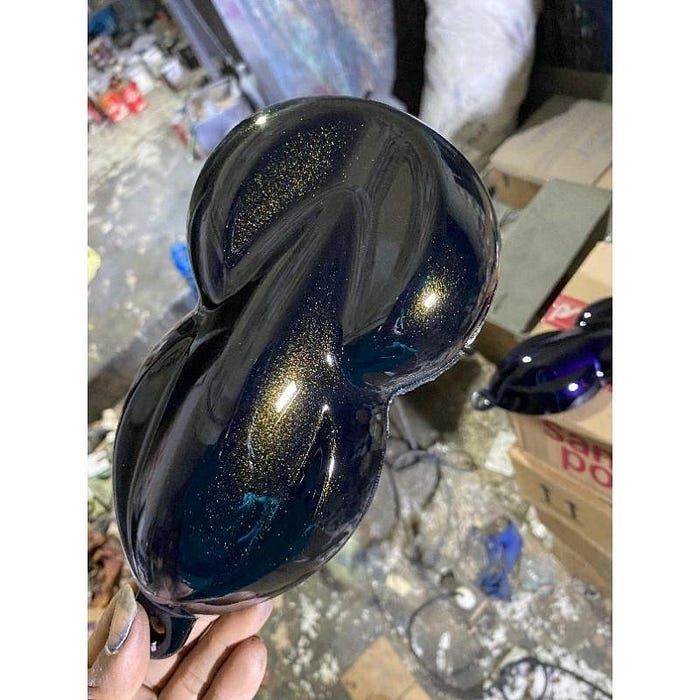
Cat Moonblack gold PU

  Cat Moonblack gold PU  adalah salah satu series yang mengandung partikel kecil seperti crystal yang dan memiliki effect lebih gelap sehing...