Showing posts with label race consciousness. Show all posts

Saturday, January 22, 2022

What is the controversy about this magazine cover at British Vogue?

Consider the question for yourself before reading the criticisms.

At Instagram, British Vogue says: "The nine models gracing the cover are representative of an ongoing seismic shift that became more pronounced on the SS22 runways; awash with dark-skinned models whose African heritage stretched from Senegal to Rwanda to South Sudan to Nigeria to Ethiopia. For an industry long criticized for its lack of diversity, as well as for perpetuating beauty standards seen through a Eurocentric lens, this change is momentous."

At CNN, a writer based in Nigeria says: 

Why are the models depicted in a dark and ominous tableau, the lighting so obscure to the point they are almost indistinguishable on a cover meant to celebrate their individuality? Why were they dressed all in black, giving a funereal air, and an almost ghoulish, otherworldly appearance?

Why were they sporting strangely-coiffed wigs? Many of these women wear their natural hair normally and it would have been great to see that reflected on a cover celebrating African beauty. Additionally, on the cover, the models' skin color appeared to be several shades darker than their normal skin tone.

The photographs were taken by Afro-Brazilian photographer Rafael Pavarotti, and the images -- published in numerous glossy magazines over the years -- are consistent with his visual style of presenting Black skin in an ultra-dark manner....
But the lighting, styling, and makeup, which purposefully exaggerated the models' already dark skin tones, reduced their distinguishing features and presented a homogenized look. Was this the best way to celebrate Black beauty?...

Should we ask what's the best way to celebrate black beauty or what's the vision of the artist/photographer? Pavarotti is black, so to push him back and say he's doing it wrong is to reject a black vision, to put him in a lower position that all the photographers whose visions are respected. And yet, the artist and model relationship has long been a matter of critique, and Pavorotti shouldn't get special immunity from criticism.

Many online critics felt the images were fetishized and pandering to a White gaze, ironic, considering the editorial team behind them consisted almost entirely of people of African descent. 
Ghanaian writer Natasha Akua wrote in a private message on Instagram: "When I saw it I immediately was shocked ... I feel like I know what statement he was trying to make visually but turning these black models into this strange tableau straight out of a horror movie just felt instinctively wrong." 
"Why darken their skin beyond recognition?" she asked. "To make some statement about being unapologetically black? Unapologetically black means being who you are and does not require this manner of hyperbole." 
"I find the lighting and tones beautiful," Daniel Emuna wrote. "But my personal complaint is that publications and brands are constantly communicating that the deepest darkest hue in complexion represents the truest essence of Blackness or even Africanness. This is clearly a mark of the white gaze."

Monday, January 11, 2021

If the "Capitol mob" was "a raging collection of grievances and disillusionment" as The Washington Post says...

... in its headline, here, then doesn't that mean it wasn't an "insurrection" or much of a plan at all, just a coming together of disparate elements? Let's look at the long article. I'm reading it for the first time and making excerpts and comments as I go. I'm doing this without an agenda, just wanting to figure out what the hell happened and what it means.
Those who made their way to the grounds of the U.S. Capitol on Wednesday hail from at least 36 states, along with the District of Columbia and Canada, according to a Washington Post list of over 100 people identified as being on the scene of the Capitol. Their professions touch nearly every facet of American society: lawyers, local lawmakers, real estate agents, law enforcement officers, military veterans, construction workers, hair stylists and nurses. Among the crowd were devout Christians who highlighted Bible verses, adherents of the QAnon conspiracy theory and members of documented hate groups, including white nationalist organizations and militant right-wing organizations, such as the Proud Boys. 
The list is just a limited cross section of the thousands of people who descended upon the area, yet some striking commonalities are hard to ignore. Almost all on the list whose race could be readily identified are White.

Not sure how that is done. But okay. The Washington Post seems to have compiled a list of 100 people — a hundred out of what? "thousands"? — and it's making assertions about these people, somehow "readily identifying" their race and capitalizing "White." How many of the 100 were in the category whose race was "readily identified"? 10? 80? I have no idea.

Most are men, yet about one in six were women...

2 grammar mistakes there. It needs to be "one in six was a woman" to get subject/verb agreement, and, for parallelism, it needs to be either "Most were men, yet about one in six was a women" or "Most are men, yet about one in six is a women." We can argue about whether past or present tense is worse (or an outright error). But enough tripping along the pleasant side road that is grammar. Back to the substance:

... also almost all White. Many left extensive social media documentation of their passions, ideologies and, in some cases, disillusionment and vendettas.

Great. This is what I've been waiting for. Reading the social media of the various participants in the breaching of the Capitol. 

Their paths to the nation’s capital were largely fueled by long-standing grievances and distrust, and yet planned in spontaneous and ad-hoc fashion.

Was there a plan?  If it was "spontaneous and ad-hoc" then maybe it was not a plan, just diverse individuals whose paths flowed together at that place and time?

Several reported pulling together their travel funds and schedules in just a handful of days. Some took a solitary journey, including flying from coast to coast alone, only to find a shared community upon their final destination in Washington. Others traveled in buses that departed Wednesday at dawn, filled to the brim with other Trump supporters....

Don't mix up the plan to go to a big rally and street protest with a plan to break into the Capitol (and don't mix up a plan to break into the Capitol with a plan to take Mike Pence or members of Congress hostage).

Several who traveled to Washington to support the “Stop the Steal” rally told The Post they were driven by two primary grievances: their opposition to the election results and the restrictions in place to stop the spread of the coronavirus. Lindsey Graham...

Interesting name. 

... a 39-year-old entrepreneur from Salem, Ore., said her eventual path to the Capitol began last spring, when the six small businesses she and her husband own, including tanning salons, a gym and hair salon, were suddenly shuttered because of coronavirus restrictions...  Graham said she was “peacefully protesting” with thousands of people. She said she did not enter the building and does not condone violence. “I’m glad I was there because I am one of the people that can vouch for the crowd,” she said. 
Like Graham, 47-year-old construction worker Pete Harding said he was drawn to the Capitol by his disdain for restrictions to stop the spread of the coronavirus. Until last year, the Upstate New York resident said he had largely confined his strong political opinions to the Internet, describing himself as just a “keyboard warrior.” That’s all changed now, in radical fashion. The first days of 2021 found him — by his own account — charging through the chemical irritants that Capitol Police meant to deter him from entering the U.S. Capitol, rambling through the building, and then attempting to set fire to journalists’ equipment outside.... 
“We know that if Biden-Harris was going to get into office, they’ve said they’re going to make the lockdowns mandatory and mask-wearing mandatory across the country,” he said....

This article is making the lockdown seem more central to the protest than the idea that Trump won the election. 

After listening to Trump’s speech and marching to the Capitol, he found that “our people,” as he described the mob, had already pushed police back up to the top of the Capitol steps.

So Harding doesn't seem to be part of any plan to breach the Capitol, just a person in a crowd who finds out that in some other part of that crowd, something violent is happening. This reminds me of Black Lives Matter events, where there were peaceful protesters in some places and violent people in other parts. Is the whole mass to be called a "mob," with everyone who went to the event held responsible for what everyone else does? The answer should be no.

He waded through the crowd to join them, and persisted up the stairs, though he says police repeatedly deployed irritants to try to deter the mob. Harding describes himself as a “peacekeeper” who charged up the Capitol stairs to protect both police officers and rioters. 
“I started to see everybody going up the stairs at that point, and I decided I needed to be up there. … I knew that things could escalate and I needed to be there to de-escalate things,” he said. “I was there to protect and keep the peace. That’s what I do every single place that I go.”

By his own account, Harding made an independent decision to enter after the breach was made, and he has the image of himself as a "peacemaker."  

Harding said that the only weapon he carried was a dinner fork, which he put in his pocket because he believed he might need it to confront “antifa” or “Muslim brotherhood” fighters. 
It stayed in his pocket. “Fortunately, I didn’t have to wield the kitchen fork menacingly,” he said.

I hear that statement as humorous, though you could do some damage with a fork. Harding also seems to have believed, as I think many do, that any violence was attributable to anti-Trump forces — “antifa” or “Muslim brotherhood."

Once he left the Capitol, he saw journalists with cameras protected by barricades. He says he walked over twice to taunt them, saying, “You’re responsible for this” and “There’s a woman shot — this is on your hands.”

Harding claims that only after he walked away did other Trump supporters harass the journalists to the point that they fled, leaving behind their equipment. He was delighted. “I was kind of happy about it, to be honest with you, not going to lie, because they deserve it. But that’s not a crime,” he said. 

He said he came back and piled up the abandoned equipment, then used a lighter to try to set it on fire though he believed most of it was metal and wouldn’t burn. 

“The visual and the imagery was for the media to see, that they have started our country on fire,” Harding said, “with their constant lies about covid and about Trump.” Harding maintains that he did nothing illegal Wednesday....

Clearly, some of what Harding did is illegal, but — by his own account, assuming he's correctly and fairly quoted — he seems like an independent actor, making his own decisions according to his idea of what is true and good, and not part of a group plan. Just to be clear: I completely oppose the intimidation of the reporters and the damaging of their property. 

Many attendees described a type of fervor they felt that drew them to the Capitol. For 48-year-old Leonard Guthrie Jr., it manifested in his faith in the Lord. The Cape May, N.J., resident hasn’t often been well enough to work since having two surgeries on his back. In the absence of employment, he has heavily leaned into his Christian beliefs and conservative political views. When he heard about the “Stop the Steal” rally, Guthrie thought he could combine his two passions. If he and other Christians had been able to pray outside while senators voted inside, he feels certain it would have changed their votes.... 

He said he broke through a police barrier to reach the U.S. Capitol steps and readily admits his transgressions, bluntly saying: “I broke the law.” Still, he feels aggrieved. “We’ve been silenced for so long,” he said. “For years, because I voted for Trump, I’m called a racist, a Nazi, a bigot and all that stuff, and it’s not right.”

Again, this sounds like an individual making his own decision in real time, not a participant in any plan to enter the Capitol. He wanted to pray outside, and it sounds as though he didn't go inside, but only to the steps, though he did break a barrier, and he's confessionally sorry. 

Others squarely cited their fealty to the president as the force that pulled them to the nation’s capital....

This is a screwy way to blame Trump. Trump is a man, not a force. If the "fealty to the president" is a "force" within people who love him, then "pull" is the wrong word. That wrongness is the tip that WaPo is straining to blame Trump. In any case, this is only saying people were drawn "to the nation's capital." That's only saying they chose to go to the city, not that they felt drawn to enter the Capitol building.

Now, I've read the whole thing. There's nothing here about a plan to break into the Capitol! That doesn't mean there weren't people with such a plan, and I can see why such people wouldn't want to talk to the Washington Post, but this article supports the idea that the crowd consisted of individuals who were acting independently. 

Saturday, January 9, 2021

"For many congressional staff members and Capitol workers, in particular people of color, the damage wrought on Wednesday was visceral."

"It will be a long time before they feel safe again at work, they say, knowing that a building once thought to be among the most secure in Washington could be breached by a mob carrying, among other things, a Confederate flag and displaying anti-Semitic iconography.... The Capitol Police have come under fire for seeming, at times, to offer little resistance to the pro-Trump mob. While some experts defended their actions as prioritizing the protection of lawmakers over the securing of the building, many congressional staff members, along with custodial and food service workers, were left wondering whether they were safe.... Black staff members in particular said the rampage had reminded them of the struggles they had often had to come to terms with in order to work for Congress.... One Black congressional staff member who also took a walk through the Capitol to survey the aftermath on Wednesday night said that despite all the damage, he had been stopped in his tracks outside Representative Steny Hoyer’s office, where a poster honoring John Lewis, the congressman and civil rights leader who died in August, had been displayed. It was missing. He looked for it feverishly and found only a broken piece on the ground next to a trash can. The image of Mr. Lewis was gone. All that remained of his celebrated quote, 'Get into good trouble, necessary trouble,' were the final two words — smudged by a boot print."

"In late December, Ms. Ponsetto was caught on video tackling Keyon Harrold Jr., the 14-year-old son of a prominent jazz musician, in the lobby of a boutique hotel in SoHo."

"She had falsely accused him of stealing her cellphone, and can be heard yelling, 'No, I’m not letting him walk away with my phone!' The video, which garnered widespread consternation on social media, was yet another example of Black people in America being confronted with baseless accusations while simply going about their lives. It drew comparisons to an incident in May, in which a white woman called 911 to falsely claim that a Black bird-watcher in Central Park had threatened her life. (Ms. Ponsetto, her lawyer said, is of Puerto Rican and Vietnamese descent.)"


This story would have "garnered" so much more attention — and, of course, "consternation" — if only Ms. Ponsetto had been white. The Times calls it "another example," but it's not really in the category for which examples are being... garnered. Ponsetto is, her lawyer says, of Puerto Rican and Vietnamese descent, and she's not even charged with a hate crime — because, according to the police, "she didn't say anything about that." 

Why is the charge robbery and not assault? Is there evidence that she knew the phone was not hers?

As for that interview with Gayle King, Ponsetto's lawyer says, "She went off script,. She decided to disregard my advice and just go on her own... She was prepared and guided. She apologized, but not in the way she should have. But she said so many other things that it almost blurred her message. It was so disrespectful." The lawyer called her client disrespectful? Am I reading that right?


In the TV interview, Ponsetto wears a cap that reads "Daddy" and says "I consider myself super sweet." The high point of the interview comes at 4:46 when Ponsetto lifts her hand, palm out, toward Gayle King and says "All right, Gayle. Enough." Now, that's not a crime, but it does show a young woman with unusual instincts, instincts also on view in the hotel video (which you can also see in the embedded clip). 

How does a 22-year-old woman acquire that orientation in the world? I'll hypothesize that it has something to do with the self-image "super sweet."

Friday, January 1, 2021

"Minneapolis police shot and killed a man who allegedly opened fire on officers during a traffic stop Wednesday night..."

".... sparking new tensions in a city still deeply on edge since the police killing of George Floyd in May and the fiery unrest that followed. Scores of protesters quickly arrived at the site of the shooting, a gas station parking lot in South Minneapolis, about a mile from the intersection where Floyd was killed, facing off in below-freezing temperatures with police officers clad in riot gear, some clutching batons and cans of pepper spray. The tense scene, reminiscent of clashes between police and demonstrators in the aftermath of Floyd’s death, continued into early Thursday and prompted calls for peace from Minneapolis officials anxious to avoid a repeat of the May unrest that left parts of the city burned and destroyed. On Thursday evening, dozens of people began gathering at the gas station again for a vigil.... The body-camera footage appears to show the driver fire a shot through his window.... Word of the shooting quickly spread on social media, including rumors about the race of the suspect and how many times he had been shot and where...." 


You have to read the long article carefully to see that we're not told the race of the man who was shot dead by the police. We're not told, even though the writer of the article seems to have watched the video — "The body-camera footage appears to show the driver fire a shot through his window." Can't we hear what the race the driver "appears" to be? Is it simply that it's a delicate matter, guessing what race a person is? Or is it that if they say he appears white, people will say different things that if they're told he appears black? 

We're not even told what the "rumors about the race of the suspect" were! It seems most likely that the rumors were that he was black, since people were drawn out to a protest. But what if the dead man turns out to have been white? Would protest leaders shift to saying the problem is police brutality against all races? I note that they could say the police only kill a white man when he's actually firing a shot right at them. 

Friday, June 19, 2020

"White fragility is the sort of powerful notion that, once articulated, becomes easily recognizable and widely applicable.... But stare at it a little longer..."

"... and one realizes how slippery it is, too. As defined by [author of 'White Fragility' Robin] DiAngelo, white fragility is irrefutable; any alternative perspective or counterargument is defeated by the concept itself. Either white people admit their inherent and unending racism and vow to work on their white fragility, in which case DiAngelo was correct in her assessment, or they resist such categorizations or question the interpretation of a particular incident, in which case they are only proving her point. Any dissent from 'White Fragility' is itself white fragility. From such circular logic do thought leaders and bestsellers arise. This book exists for white readers. 'I am white and am addressing a common white dynamic,' DiAngelo explains. 'I am mainly writing to a white audience; when I use the terms us and we, I am referring to the white collective.' It is always a collective, because DiAngelo regards individualism as an insidious ideology. 'White people do not exist outside the system of white supremacy,' DiAngelo writes, a system 'we either are unaware of or can never admit to ourselves.'... Progressive whites, those who consider themselves attuned to racial justice, are not exempt from DiAngelo’s analysis. If anything, they are more susceptible to it. 'I believe that white progressives cause the most daily damage to people of color,' she writes. '[T]o the degree that we think we have arrived, we will put our energy into making sure that others see us as having arrived...'... It is a bleak view, one in which all political and moral beliefs are reduced to posturing and hypocrisy...."

Writes Carlos Lozada in "White fragility is real. But ‘White Fragility’ is flawed," reviewing the book "WHITE FRAGILITY: Why It’s So Hard for White People to Talk About Racism" in The Washington Post.

Thursday, June 18, 2020

"I admit to having a complicated relationship with Aunt Jemima... For a period of time in the late 1940s and early 1950s, my grandmother, Ione Brown..."

"... was part of an army of women who worked as traveling Aunt Jemimas, visiting small-town fairs and rotary-club breakfasts to conduct pancake-making demonstrations at a time when the notion of ready-mix convenience cooking was new. I never knew about my grandmother’s work until long after she died... [W]hile researching a family memoir... I learned that she made good money and covered a region including Iowa, the Dakotas, Michigan, Wisconsin and Minnesota. She was often treated like a celebrity in small towns, but could not stay in local hotels. She kept an eye out for houses that had a small sign in the window that said 'TOURIST,' a code for homes that provided lodging and meals to black people.... As a family, we are offended by the caricature that Aunt Jemima represents, but deeply proud of the way my grandmother used the stage that was available to lift herself up. You see, in those days Aunt Jemima didn’t look like the lady you see on the box today. She was a slave woman, and Ione was expected to act and talk like a slave woman, using the kind of broken patois that blighted the full-page ads in magazines like Women’s Day and Life.... One of the things that irks me most about the Jemima brand is the way the mammy stereotype hijacked what should be an endearing image for black America and tried to turn it into something toxic. Most of us have someone in our family with fleshy arms and a loving smile who serves up cherished advice along with delicious food. They are our aunts and mothers and grandmothers. Our godmothers. Our queens.
You tried to make us ashamed of what Aunt Jemima stood for."

From "Why did it take so long to set Aunt Jemima free?" by Michele L. Norris (WaPo). (Quaker Foods announced that it is retiring the Aunt Jemima brand because to "make progress toward racial equality.")

ADDED: At the NY Post, I'm seeing "After Aunt Jemima, people call to cancel Uncle Ben’s and Mrs. Butterworth’s." I understand about Uncle Ben, but Mrs. Butterworth? I've never perceived Mrs. Butterworth as black.
The syrup, sold in a matronly woman-shaped bottle, is accused of being rooted in mammy culture and was modeled after the body of Thelma “Butterfly” McQueen, the black actress who played Prissy in “Gone With The Wind.” The Jim Crow-era “mammy” character was often used to show that black women were happy working in white households....
That's news to me. I looked up Mrs. Butterworth on Wikipedia and it did not contain that information. I did learn that the voice for the character was done by Mary Kay Bergman, who looked like this:
"Her parents were Jewish," and she died by suicide at the age of 38 in 1999. She was the original lead female voice on "South Park."
Her characters included Liane Cartman, Sheila Broflovski, Shelly Marsh, Sharon Marsh, Carol McCormick and Wendy Testaburger.... Bergman credited South Park for pulling her out of a typecasting rut. 'I'm known for these sweet, cute little characters,' she said, noting her roles in various Disney films. "So I've been doing them forever. My agents were trying to submit me on shows that are edgy, and they're laughing, 'Mary Kay, are you kidding? No way!'" After Bergman's death, the two episodes "Starvin' Marvin in Space" (the final episode for which she recorded original dialogue) and "Mr. Hankey's Christmas Classics" (the final episode in which her voice was used via archive footage) were dedicated in her memory.
No comment on the role of Starvin' Marvin and Mr. Hankey in the quest for progress toward racial equality. RIP Mary Kay Bergman. Watch this (it's phenomenal):


Mrs. Butterworth voice at 1:11.

ADDED: Norris writes that her grandmother, in the role of Aunt Jemima had to use a "kind of broken patois." And I see in the comments that David Begley is asking, "Just asking, but isn’t 'broken patois' the language of today’s rap music?" Which makes me wonder, what's wrong with a patois? To answer my own question, I naturally look up "patois" in the OED.

I see that it's "dialect spoken by the people of a particular region (esp. of France or French-speaking Switzerland), and differing substantially from the standard written language of the country" or — and this is "frequently depreciative" — "a regional dialect; a variety of language specific to a particular area, nationality, etc., which is considered to differ from the standard or orthodox version."

I was intrigued by this example from "The Sheltering Sky" by Paul Bowles (who was born in New York City):
Then he remembered having heard that Americans did not speak English in any case, that they had a patois which only they could understand among themselves. The most unpleasant part of the situation to him was the fact that he would be in bed, while the American would be free to roam about the room, would enjoy all the advantages, physical and moral.

Sunday, June 14, 2020

"[W]hen things get real — really murderous, really tragic, really violent or aggressive — my white, liberal, educated friends already know what to do. What they do is read."

"And talk about their reading. What they do is listen. And talk about how they listened. What they do is never enough. This isn’t the time to circle up with other white people and discuss black pain in the abstract; it’s the time to acknowledge and examine the pain they’ve personally caused. Black people live and die every day under the burdens of a racism more insidious than the current virus that’s also disproportionately killing us. And yet white people tend to take a slow route to meaningful activism, locked in familiar patterns, seemingly uninterested in really advancing progress. Theirs is still a world of signs and signaling, where actions like joining book clubs — often based in some 'meaningfully curated' readings that are probably easy to name: 'White Fragility,' 'How to Be an Anti-Racist,' 'Between the World and Me,' maybe even 'All About Love' — take precedence.... [In social media] people write long posts about the need to examine white privilege, to 'name white supremacy,' and to either proudly denounce family members or call them in to conversations.... ... I know what happens next. In a handful of Sundays, my social media feeds will no longer have my white allies 'This'-ing, or unpacking their whiteness or privilege, or nudging their kids to put down their tablets and march. Their book clubs will do what all book clubs do: devolve into routine reschedulings and cancellations; turn into collective apologies for not doing the reading or meta-conversations about what everyone should pretend to read next; finally become occasional opportunities to catch up over wine...."

From "When black people are in pain, white people just join book clubs/I’m caught in a time loop where my white friends and acquaintances perform the same pieties over and over again" by Tre Johnson (WaPo). If you're wondering what, in Johnson's view, is the right response, I can pick out the 2 words where he says it, and when you see them, you may think it's no wonder white people don't just snap to it and do what needs to be done: "dismantle systems."

ADDED: I read the top few highest-rated comments at the link, and they were all taking issue with Johnson's stereotyping of white people. What percentage of white people react to racial strife by cuddling up in book clubs murmuring about "White Fragility" and "Between the World and Me"?

Friday, June 12, 2020

"Yes, racism is real, but as a crucial factor that enables or prevents social advancement, it has lost a lot of force in the past half century."

"I am sure that there are deep-seated inequality problems in America that affect everyone, and black people in particular. Some are institutional, but many have to do with the culture and behavior of black people themselves. I’m talking about lack of educational achievement, and about the higher crime rate; I’m talking about the collapse of the black family. Seven out of ten black children are born outside of marriage. It is a plausible surmise that households where a mother is present, but no father, are more likely to produce adolescent males with behavioral problems. People are frustrated that conventional political solutions, such as expanding anti-discrimination and welfare programs, have not worked. That’s why they take refuge in the empty thesis of racism. They speak of 1619, when the first blacks landed in America, and they speak of slavery, which was abolished more than 150 years ago. They talk of 'centuries of oppression.' But, they don’t talk about how the social condition of blacks in America well may have been healthier in 1950 than it is today—the integrity of family structure, the level of the crime rate, the relationship to work of the poorly educated, and the values with which many children are raised.... I think we do not live in a really free space where we can discuss these questions. Pressure to conform is intense because nobody wants to give the impression that they stand on the wrong side of the great moral questions of our time.... Because racists say that black crime is terrible, you are afraid even to address the issue and admit that it may be part of the problem.... So you’d rather be silent. And that gets us nowhere—or rather, it gets us to where we are today."

From says Glenn Loury in "Racism Is An Empty Thesis/An African-American professor says that blacks hold their fate in their own hands" (City Journal).

Wednesday, June 10, 2020

"In their eagerness to display dazzling empathy and solidarity, they only muddied the current conversation about race."

Writes Robin Givhan in "Congress’s kente cloth spectacle was a mess of contradictions" (WaPo).
A brief history of kente cloth would emphasize that it is the pride of Ghana, where it originated, and it is typically worn on special occasions....

[The Justice in Policing Act of 2020 isn't] “black” legislation. No one, whatever their race or ethnicity, should want inhumane police officers roaming through their city....

The stoles read as a vague and confused declaration by lawmakers that they stood together out of respect for the African-ness of their fellow citizens. What they needed to emphasize with their stagecraft is that this is a particularly American issue — a defect woven into our own country’s fabric.

Monday, June 8, 2020

"The Compton Cowboys, a close-knit club of friends, joined thousands of people for a peaceful trip through Compton on Sunday."

"The club, which formed in 2017 to dispel stereotypes against black people, welcomed all riders for a march from Gateway Towne Center to Compton City Hall."

"Seeing the brutality of a white power structure toward its poor black citizens [on the streets of Ferguson], and at its rawest, helped shape the way a generation of reporters..."

"... most of them black, looked at their jobs when they returned to their newsrooms. And by 2014... Twitter...  offered a counterweight to their newsrooms, which over the years had sought to hire black reporters on the unspoken condition that they bite their tongues about racism. Now, as America is wrestling with the surging of a moment that began in August 2014, its biggest newsrooms are trying to find common ground between a tradition that aims to persuade the widest possible audience that its reporting is neutral and journalists who believe that fairness on issues from race to Donald Trump requires clear moral calls.... The fights at The Times are particularly intense because Mr. Sulzberger is now considering candidates to replace the executive editor, Dean Baquet, in 2022, the year he turns 66. Competing candidates represent different visions for the paper, and Mr. Bennet had embodied a particular kind of ecumenical establishment politics. But the Cotton debacle had clearly endangered Mr. Bennet’s future. When the highly regarded Sunday Business editor, Nick Summers, said in a Google Hangout meeting last Thursday that he wouldn’t work for Mr. Bennet, he drew agreement from colleagues in a chat window.... Mr. Sulzberger... told me... 'We’re not retreating from the principles of independence and objectivity. We don’t pretend to be objective about things like human rights and racism.'"

Writes Ben Smith in "Inside the Revolts Erupting in America’s Big Newsrooms/Staff members’ demands helped end the tenure of James Bennet as Opinion editor of The New York Times. And they are generating tension at The Washington Post. Part of the story starts in Ferguson, Mo." (NYT).

We’re not retreating from the principles of... objectivity. We don’t pretend to be objective....

Sunday, June 7, 2020

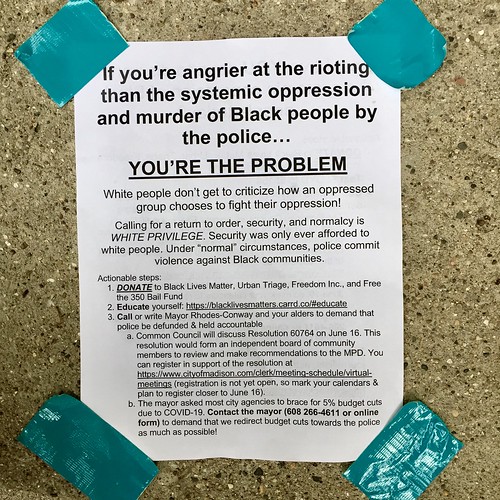
Sign posted in my neighborhood tells white people we "don't get to criticize" the choice of protesters to resort to rioting.

It's "white privilege," we are told, to express a desire for order and security:

IMG_3630

A second sign attempts to convince us to abolish the police because they "uphold an inherently racist system" and "protect whiteness and capitalism":

IMG_3628

ADDED: I anticipate that my post title will be criticized on the ground that there were a lot of peaceful protesters and we don't know whether any of them participated in anything that can properly be called "rioting." I want to keep the facts straight, and I want to know the facts. I agree that that those who broke windows and looted shops may have been an entirely different set of people from the people who were there to protest police brutality. I await the news reports and investigations that can bring these facts to light. I keep looking!

But that post title is just telling you what the sign says! It's one of the many problems with the sign. Whoever wrote that sign made no effort to separate the peaceful protesters from the rioters. It tells me to shut up about any objection I might have to the rioting because those in the oppressed group get to choose how to fight their oppression. This implies that the form of protest chosen was, in fact, theft and vandalism, and white people are not even allowed to criticize this expression.

Sunday, May 10, 2020

"Try to imagine Muhammad Ali without Little Richard’s winking persona, his swing and swagger ('I am the King!')."

"Try to imagine James Brown, the Beatles, Jimi Hendrix, Otis Redding, Bob Dylan, Mick Jagger, David Bowie, Janis Joplin, Elton John, and Prince without his electrical charge. Little Richard was an original, and he did not hesitate to remind his students of their debt. He once looked into a television camera and, with affection, told Prince, 'I was wearing purple before you was wearing it!'... Richard Penniman was born in 1932 into a large, poor Christian family, in Macon, Georgia. His father was a brick mason and a bootlegger. One of Richard’s legs was shorter than the other, making him a source of mockery among other children. 'They thought I was trying to twist and walk feminine... The kids would call me faggot, sissy, freak.'... Even as a child singer, Richard was known for his high range and incredible volume. But, in his father’s eyes, he was unbearably effeminate and not to be tolerated. When Richard was a teen-ager, he was thrown out of the house and went to live with Ann and Johnny Johnson, a white couple who ran a local venue, the Tick Tock Club.... Throughout his teens, he was in and out of outfits like Buster Brown’s Orchestra (where he got the name Little Richard) and the Tidy Jolly Steppers. He sang, sometimes wearing a red evening gown, under the name Princess Lavonne, in Sugarfoot Sam’s Minstrel Show."

From "Little Richard, the Great Innovator of Rock and Roll" by David Remnick (The New Yorker).

I wanted to find a photograph of Little Richard in the Princess Lavonne persona. I did find this description at Talkhouse, "Pour on the Steam: Little Richard at Age 19/Adam Weiner (Low Cut Connie) tells a tale of magical personhood in a Macon, Georgia bus station":
It was a medicine show spiritualist pseudo-psychic passing through town named Doctor Nobilio who was the first to tell Richard he would be massively famous—he just needed to get the hell out of Macon. He quit high school and joined up with a series of amazingly-titled rinky-dink traveling shows, initially billed as Little Richard, and then as the great Princess Lavonne. He performed with Dr. Hudson’s Medicine Show, Sugarfoot Sam from Alabam, the Tidy Jolly Steppers, and the Broadway Follies. Princess Lavonne was an intense, hilarious Queen in Pancake 31 makeup. He worked on his schtick, but ultimately was an awkward drag performer. He had a natural gift to electrify and seduce, but with his mismatched legs, he couldn’t figure out how to walk or dance in heels so he would just stand still and wait for someone to open and close the curtain...
I'd also love to hear the story from the perspective of Ann and Johnny Johnson. Who were these white people who took in Little Richard when his father was so cruel to him? Or was his father cruel to him?
Bud Penniman. What voice did that man have?

Tuesday, May 5, 2020

"Melville’s ever-philosophical narrator, Ishmael, asks: 'Who ain’t a slave? Tell me that.'"

"From a world he experienced as spherical from atop ships’ masts, Melville perceived a sea-level humanity, embracing and celebrating the latitudes and longitudes of human variation, now termed diversity. When Ishmael finds himself compelled to share a blanket at the sold-out Spouter Inn, he declares, 'No man prefers to sleep two in a bed.' But he settles in, waiting for his mysterious South Seas roommate who, he’s informed, is peddling a shrunken head on the streets of New Bedford. Queequeg’s appearance terrifies Ishmael mute. But after things equilibrate, Ishmael reconsiders: 'For all his tattooings he was on the whole a clean, comely looking cannibal … a human being just as I am. … Better sleep with a sober cannibal than a drunken Christian.'... Reflecting on Queequeg’s tatted visage, he concludes: 'Savage though he was, and hideously marred about the face — at least to my taste — his countenance yet had a something in it which was by no means disagreeable. You cannot hide the soul. … Queequeg was George Washington cannibalistically developed.'... Nearly two centuries ago, Melville showed us how easy it is to welcome as our own the touches of others, their equivalent colors, customs and beliefs; their journeys, their transitions. And to remember those who, unwelcomed, suffered. How much could have been avoided, and embraced, had we heeded...."

From "Melville’s Whale Was a Warning We Failed to Heed" (NYT).

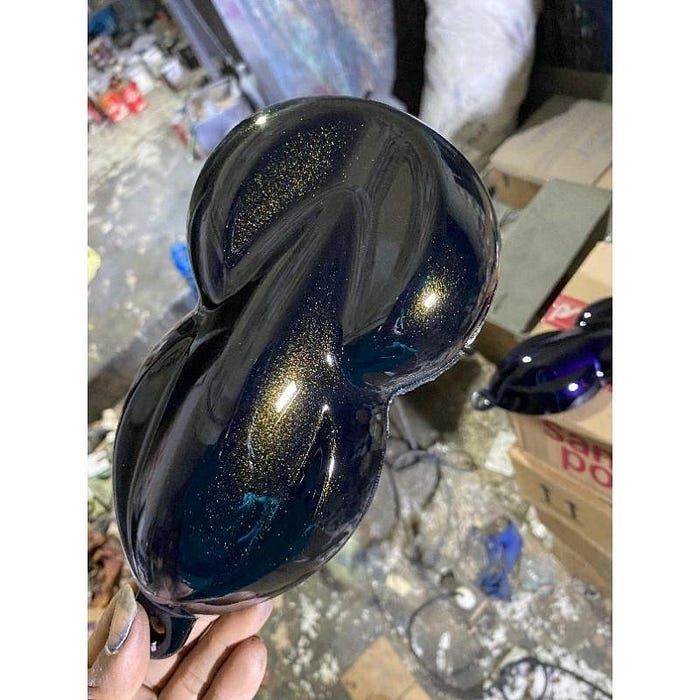
Cat Moonblack gold PU

  Cat Moonblack gold PU  adalah salah satu series yang mengandung partikel kecil seperti crystal yang dan memiliki effect lebih gelap sehing...