Friday, August 24, 2012

Van Gogh's The Starry Night

"In the blue depths the stars were sparkling, greenish, yellow, white, pink, more brilliant, more sparklingly gemlike than at home - even in Paris."1

So wrote Vincent Van Gogh while he was in Saint-Rémy during the time when he painted his famous painting, The Starry Night.  Van Gogh created this painting, one of his most famous works of art and a favorite of mine, in June of 1889 about a month after he moved to the mental asylum in the small town of Saint-Rémy outside of Arles where he had been living.

While Van Gogh was at the asylum he painted constantly, taking his inspiration from the views out of his window and the countryside around him.  Just six months earlier he had a mental breakdown in Arles and mutilated his own ear, which was followed by a lengthy stay at a hospital. 
His time in the asylum at Saint-Rémy was an especially prolific time in his painting career and The Starry Night was influenced by the night sky as seen from his window there.

The Starry Night, Vincent Van Gogh, 1889, 29 x 36 1/4" (73.7 x 92.1 cm)
Museum of Modern Art (MOMA), New York

Art Historian Robert Rosenblum wrote of Van Gogh:

"Of the many marvels that make up Van Gogh's genius, one is his uncanny capacity to project his total visual and emotional attention into anything he painted, animate or inanimate, so that a shoe, a sunflower, a chair, a book could carry as much weight as the image of a human being."2

This statement is also true of his landscapes.  Van Gogh's night sky does seem to vibrate and swirl with its own personality and the vivid hues of the stars, sky, moon and cypresses have a near anthropomorphic quality lacking in the landscapes of the French Impressionists whose work influenced his style.

While such painters such as Claude Monet, Pierre-Auguste Renoir, Camille Pissarro and Alfred Sisley were interested in capturing the color and light in a landscape, Van Gogh filled his with emotional and symbolic meaning. 
In the town (which is imagined) the only building to rise above everything is the church with its steeple touching the sky.  That same form is echoed in the foreground with the shape of the cypress trees also touching the heavens.

Van Gogh trained as a preacher and spent time working in that profession in the Netherlands before he took up painting.  Is the church in this painting and the fact that the steeple rises over the hills symbolic?

 The Starry Night, pen and ink drawing, Vincent Van Gogh, 1889, 18.5 x 24.5"
Museum of Architecture, Moscow

Van Gogh loved to draw also and frequently sketched out drawings first of works he would later paint in oils.  The pen and ink drawing Van Gogh did of this painting is strikingly similar, however he did make a few alterations in his final painted work.  The moon is smaller in the painting and tilted at a slightly different angle.  The cypress is darker and the smoke which rises from chimneys in the drawing to connect the town with the sky is gone.  

Yet he managed to create the same feeling of vibrant swirling movement in his drawing and creates a work of art which is far from the quiet and serene landscape one would imagine when picturing a starry night in a small rural town.

A Wheatfield with Cypresses, Vincent Van Gogh, 1889

This landscape painting with cypresses was also painted while Van Gogh was at Saint-Rémy a few months after The Starry Night and done in September.  Van Gogh actually painted three very similar versions of this painting.  The composition seems to be a mirror image of The Starry Night, done in the daylight with the cypress trees framing the scene, rolling hills in the background and whirling clouds replacing the nighttime stars.


 La nuit étoilée (The Starry Night), Vincent Van Gogh, 1888, Musée d'Orsay, Paris

While Van Gogh's The Starry Night is a unique style of landscape painting, he included the night sky in a few of his other works.  One example is his earlier version of a starry night (shown above) painted in September 1888 while he was living in Arles.  Here he portrays the city as seen from the Rhône river and the brightest lights are those which are reflected in the water rather than the stars.

Vincent Van Gogh was known to have painted outside with candles placed in his hat so that he could see to work at night.  In a letter to his sister during the same month that he painted this view of the Rhône at night, Vincent wrote:

"Often it seems to me night is even more richly coloured than day."3

Never does this statement seems to be more true then when viewing Van Gogh's nighttime landscape paintings. 


1 Feaver, William. Van Gogh, The Masterworks. New York: Portland House. (1990) p. 41. 
2 Rosenblum, Robert and H.W. Janson. 19th-Century Art. New York: Harry N. Abrams, Inc. (1984) p. 414.
3 Quote taken from the Musée d'Orsay website on the page for La nuit étoilée.


Sunday, August 5, 2012

The Frescoes of Akrotiri

The Ancient city of Akrotiri on the Greek Island of Santorini (then known as Thera) can be likened to a much earlier version of Pompeii.  This Minoan city was buried in an enormous volcanic eruption that occurred on the island sometime between 1,800 and 1,500 BC.

There are a lot of unknowns about this Bronze Age civilization which was named Minoan by later historians after the mythical King Minos of Crete.  The largest Minoan settlement was found on Crete in the city of Knossos.  The earliest form of their language (known as Linear A) has not been deciphered and timelines of events are approximated.  We aren't certain what the Minoans actually called their own civilization or what their religious beliefs were.  Was there any truth to the myth of King Minos from Crete?  The later form of language (known as Linear B) has been deciphered but 99% of it was used in taking inventory of goods or for administrative purposes which doesn't tell historians much about the overall history of this fascinating civilization.


However Minoan art, including these frescoes from Akrotiri, helps to shed some light on this society that thrived in the Aegean four thousand years ago.

The Springtime Fresco, from Room Delta 2,Complex D
Akrotiri, c-1,500 BC

The Springtime fresco is the earliest work which is entirely a landscape painting that has been found in the ancient world.  This fresco covered at least three walls in the room it was found in.  As we can see the imagery is stylized and abstracted rather than being a more naturalistic representation of hills and flowers.  The landscape is painted as colorful, bright and expressive with a playful inclusion of swooping birds.  It is not known what the room that this decorated was used for or why they chose to fill the walls with landscape painting.

Minoan painting can be differentiated from the arts found in other bronze age civilizations such as Egyptian and Mesopotamian due to the subject matter.  Most Minoan fresco subjects were scenes from daily life rather than paintings created to honor Pharaohs or gods. Also the Minoans used the true wet fresco technique of painting with pigment into plaster made with limestone to seal the painting to the wall, rather than the dry fresco technique used in Egypt.

However there were also some similarities, the two frescoes below show how the Minoans also used the same "twisted perspective" seen in figurative art through the centuries in ancient civilizations.  We can find examples of this in Mesopotamian relief carving as well as Egyptian fresco.  Twisted perspective refers to the fact that the feet and legs are shown in profile, but the torso is shown frontally.  The head is also in profile, while the eye is shown frontally.


Boxing Boys Fresco, Room B1, Building B
Akrotiri, c-2,000-1,800 BC

Young Fisherman Fresco
Room 5,                                                        
West House, Akrotiri, c-1,500 BC 

The above two figurative frescos are also good depictions of daily activities that were common in Akrotiri.  Apparently Minoans shaved their head but for some long locks, the shaved head is shown as blue and the long locks as black. Another similarity to Egyptian art is how men were depicted as having darker tan skin and women were shown having pale skin.

As the Minoan civilization was centered on the Aegean islands there is a wealth of marine life imagery shown in their art, such as the fish in the Young Fisherman Fresco and the swimming dolphins shown below in the Flotilla Fresco.  Vases were painted with octopi and on the main island of Crete there were fish and dolphins painted in the Palace of Knossos. 


The Flotilla Fresco, from one wall in Room 5, West House,
Akrotiri, c-1,500 BC

The enormous fresco known as The Flotilla Fresco from room 5 of the West House gives the modern viewer a more detailed look at daily life in this culture.  This fresco wrapped around three sides of a room, it is approximately 39 feet (12 m) long and yet only 17 inches high (43 cm) in a frieze like style.  

Ships are shown sailing from one island to the next while people wait for them in the towns, deer are chased in the hills and dolphins swim in the sea.  Is this too a panoramic scene of daily life?  Or instead the retelling of a historic even or mythic story?

Detail of The Flotilla Fresco, from Room 5,
West House, Akrotiri, c-1,500 BC

What seems apparent from this fresco, the ruins at Akrotiri and some small faience plaques found at the site is that the Minoans were building multilevel residential structures complete with exterior windows.  These dwellings were quite sophisticated and architecture such as this wasn't found elsewhere in the Bronze Age.

These are just a small sampling of the many remains of Minoan frescoes, due to the volcanic eruption at Akrotiri this site has kept a high concentration of these paintings intact.


Suggested reading for more information on the Minoan civilization
The Aegean Bronze Age. Oliver Dickinson. Camridge University Press: Cambridge, 1994.
The Arts in Prehistoric Greece. Sinclair Hood. Penguin Books: London, 1978.


Sunday, July 29, 2012

An Effective Video Editing Work Flow

Perhaps you are one of those individuals who consider the thought of editing a video a little frightening especially if you haven't ever done this up to now. The fundamental principles of video editing are simple and this article should help ensure that you can have a completed project that you are able to share.

You probably are looking at the difficulties which you may face for instance, how to move the video files across to the video editor, how to isolate the pieces that you want and where to put them or how you will generate a final video which might be watched by others?

Each of these are issues you would undoubtedly be wondering about if you had never done this before. If you have taken your video files off of your device and across to your laptop or desktop then you are fundamentally off to a start.

First you should get your video files into the video software program library. At this time it's a good option to ensure they are clearly labeled and arranged to help you find them effectively at a later date.

The application library is the place you can build simple sequences of video. This can be done by building the segments gradually until you have the complete product.

All you need to do after that is to output the whole lot as a new video file and you are finished.

All of this may seem somewhat overwhelming but that is ultimately how it is performed and you will be pleased at how uncomplicated modern video editing software makes it.

To view all this occurring you must have the preview display available. This is one of two windows which are typically accessible when you open the program. The preview display is often times over on the left area of your computer screen.

The significance of the preview pane is that it enables you to truly observe the video clips that you are working with at that moment so that it is simple to decide upon what has to be done. After you have made a decision you may then correct anything you need to.

Simply put, that's the place where you focus on the approximate intentions before you make your final production.

After you have the individual scenes in the state you require then you can insert them onto the timeline. The timeline is frequently down below the preview panel and is where you can arrange your finalized production into a full movie.

The time line is also used for scene transitions as well as assorted filters.

With regards to right side of the display you will notice a window that points to the library. This window allows swift visible entry to items like your current video, image and audio files. It is from that window that one is ready to drag elements onto the time line.

Primarily you achieve all your editing on the time line. When you have located the various clips you can subsequently simply situate them any place on the time line. In this way it is easy to ensure your video plays back the way you really want.

It may seem that piling all of your resources on to the time line before you begin editing is the approach to take, but it is actually best to trim as well as adjust the video clips before getting to that phase.

Get your whole collection of clipped video clips onto the time line for starters and insert any transitions you desire to use in between any of the clips. At this time you should also insert any intro sequence such as movie titles plus an ending segment.

The final phase is generally fine-tuning and tweaking the audio track of the project. This is conducted last mainly because editing and trimming clips can throw the audio off. By performing this right at the end you can keep control of the way you want the audio to play and have uniformity throughout.

Once you have finished the video you may then decide how you want it to be seen by choosing the video file type.

Most video editing programs will give you a choice of video file types dependent upon just how you would like the video to get distributed and these are super easy to choose from inside the computer program. All that's left to do is decide on the location and render it to your laptop or computer much like you would any other sort of file.
Advertise with my Blog

Wednesday, July 18, 2012

Hollywood on Producing Black Films

The political and economical reality according to filmmaker George Lucas

African American filmmakers and other prominent figures should establish a distribution system to market black films across the globe. Hollywood admits that even with an Academy Award winning name like Cuba Gooding Jr. they still don't know how to market black films, according to filmmaker George Lucas, director of "Star Wars". In a recent interview with Jon Stewart on the Daily Show, Lucas appeared as a guest promoting his new film "Red Tail", a story about the African American World War II heroes, the Tuskegee Airmen. With an all African American cast starring Cuba Gooding Jr. with R&B singer and song writer Neo, this is a Lucas film 23 years in the making and personally financed. Lucas laid out the political and economical views of the Hollywood Movie system in regards to the production and distribution of black films. He stated that he wanted to make an inspirational film for teenage boys and highlight the African American patriots that helped to make this country what it is today.


The troubling part of this interview was Lucas's story about getting the film distributed. He admits that all of the studios turned it down and expressed views that they didn't know how to market a film like this (Red Tail) because it had no 'green' in it. What did they mean by this? That there is no money in it or the fact that there were no major lead roles with white actors and therefore that no real money can be made? Lucas stated that the studios even refused to release Tyler Perry movies and referred to them as being' low budget films handled by a lower level distribution system'. He said that films like Perry's actually do pretty well but the major studios don't touch them. He said "Red Tail" actually cost him more money to make than what a Perry film earns in box office revenues. The studios believe there's no foreign market for it and that relates to 60% of their profit. Lucas said that "Red Tail" is one of the first all black action pictures ever made. This is incorrect because there are many all black action pictures that have been produced, especially some of the black exploitation films of the 1970s that starred black actors, however Hollywood just didn't embrace them. There are many that exist today that just don't make it to the big screen.

In the interview, Jon Stewart jokingly asked Lucas "Now, the scene in it when Hitler tells Cuba Gooding Jr. that he's his father?". The audience burst into laughter. Well, what are you actually saying Jon? Maybe lines like this are the real reason Hollywood don't know how to market black films. George Lucas said of the Tuskegee Airmen, "They are the true heroes of World War II" and also expressed that those who are still alive showed great emotion, came up to him with tears in their eyes, thanking him for making a film that finally recognized them.

The reality of telling our stories with integrity and depth and getting them to market is falling on the shoulders of the independent filmmakers producing them. Most black filmmakers go into debt and bankruptcy because they believe that their stories have substance, a great purpose and markets waiting to embrace them, even when Hollywood fails them. Black business owners have a responsibility, and should not only take from the consumer but give back, which most of them do. Black businesses should start supporting, sponsoring and financing African American films like never before. They will make a great contribution towards educating African Americans as well as many other ethnic groups who are clueless to the depths of the real African American experience.

I believe that there is a foreign market for African American films and those in Hollywood are just not interested in telling those stories. You know what? That's OK because the stories they do decide to tell, they seem to tell upside down anyway. If there were no foreign market for black films then why did Viacom spend 3 Billion dollars to acquire (BET) Black Entertainment Television Holdings in 2001? At the time of the BET purchase, the programming was airing in approximately 62 million African American households and watched across 14 countries. Somebody is tuning into the black experience via television. Why would EMI Publishing pay former Motown founder Berry Gordy 132 million dollars for rights to those (Motown/Jobete publishing) oldies that did extremely well in foreign countries? It certainly looks like there's a foreign market to me.

Recently Damon Diddit and Natural Langdon, independent African American filmmakers from Brownsville Brooklyn in New York City, produced a film depicting the realities of life in their community called "Bullets over Brownsville" and were invited to Berlin, Germany where the movie screened at a film festival. They also produced a reality program of that experience called the "Unglamorous Life of Filmmaking. Now, it certainly looks like there's a foreign market to me. It's very strange that George Lucas would speak out openly about the Hollywood movie system and their views when they pay him millions to make films. I wonder; is this a publicity stunt designed to get blacks into the theaters on January 20, 2012?

The Salon des Refusés

In 1863 for the first time ever an exhibit was created in Paris from the artwork which was rejected by the jurors of the Salon of the French Academy.

The French Académie Royale de Peinture et de Sculpture was founded in 1648.  The Academy set a very high standard for artists and had a specific set of guidelines for students to follow.  French artists of that period sought to create art in the manner of Ancient Classical works, Raphael and Poussin (1594-1665).  There was a strict hierarchy in the importance of a painting based on subject matter, the apex being history painting and still-life painting was at the bottom (still-life in French is "morte nature" or dead nature).

 In 1666 the French Academy in Rome opened, and then a century later the British Royal Academy in 1768.  The Academies provided a place to train artists worthy of royal commissions.  Because of its association with royalty and the upper classes in society, the Academy was closed by the public during the French Revolution in 1789.   

 The Birth of Venus, Alexandre Cabanel, 1875 copy of his 1863 painting

In 1795 the academy was re-opened as a state school under the name of École des Beaux-Arts.  In the École students learned drawing, anatomy and perspective.  The new Academy, which was opened again as a branch of the school in 1816, also taught history painting.  The tradition of a strict hierarchy of work continued, painting in a classical tradition or history painting was still considered the highest form of art.

Besides being an art school, the French Academy also held regular "Salons" or art exhibitions, biannually and later annually of both students and members of the art world who wanted to exhibit their work and attract the attention of possible patrons.  Since the hierarchy and guidelines at the Academy were so rigid, there were hundreds of artists who were rejected from each of the Salons by the jury. 

Of the works that were accepted to the 1863 Salon, Alexandre Cabanel's Birth of Venus (above) was the recipient of much acclaim and was even purchased by Napolean III.  Cabanel made several copies of this painting which was influenced both by ancient art and the Renaissance.


Luncheon on the Grass, Manet, 1863, Musee D'Orsay, Paris


However in 1863 more than half of the works of art, over 2,000, that were submitted by artists were refused. Which is why in that same year the first "Salon des Refusés" was held, giving those artists another chance to exhibit their work.  The idea for this alternative Salon was that of Napolean III who felt that the jury was much too strict and that the public should have a chance to decide for themselves.

As Robert Rosenblum writes in the book 19th-Century Art:

"Napoleon III himself, having seen samples of the rejects, could find little difference between them and those selected for the official Salon, and the temporary exhibition space seemed a happy compromise.  This so-called Salon des Refusés, however, immediately took on the stature of a counterestablishment manifestation, where artists at war with authority could be seen and where the public could go either to jeer or to enlarge their ideas of what a work of art could be.  The counter-Salon opened two weeks after the official one, on May 15, and immediately attracted hordes of Parisians, who numbered as many as four thousand on a Sunday, when admission was free."*


Metropolitan Museum of Art

Not every artist wanted to be part of a "reject's gallery of art", but Édouard Manet submitted three paintings which he displayed as a triptych.  The centerpiece of this, and perhaps one of the most well known works of the 19th century is his Luncheon on the Grass, a work that also reflected Italian Renaissance ideas but with subjects shown in a modern setting.

While it was ridiculed by some critics at the time, it was also praised by writers such as Emile Zola.  The Luncheon on the Grass was instantly an influential painting and many artists were to be influenced by Manet's contemporary style, broad brushstrokes, modern figures and flattened areas of color.  It appeared to many to be a painted sketch that would have later been turned into a finished painting.  Manet was influenced quite a bit by the Old Masters in much of his work, in particular this work shows influenced by Titian and Raphael.
 Manet's favorite model Victorine Meurent, the same model who posed nude in Luncheon in the Grass,was also featured in his Mademoiselle V (above) showing her dressed as a traditional matador.

 Symphony in White no 1: The White Girl - Portrait of Joanna Hiffernan,  
James Abbott McNeil Whistler, 1862, National Gallery of Art (Washington, D.C.)

Manet was not alone in presenting unknown subjects using loose brushstrokes.  James Abbott McNeil Whistler's painting known as The White Girl, was more focused on all the different colors that white can appear in a work than on its subject, who was his mistress.  In this painting we see a work with no story or historical reference, in this sense neither Manet's nor Whistler's paintings would have been considered hierarchically important enough to have been chosen for the Salon.  Whistler was more concerned with light and shadow and the composition of the subject.  In fact it was Whistler who coined the phrase "art for art's sake" which was not a common concept in the mid-19th century.

Art was created for many reasons through the centuries: to memorialize an event, to teach, as political propaganda, for prayer and devotion, to pay honor to someone, but the idea of creating art for art's sake was relatively new.


Homage to Delacroix, Henri Fantin-Latour, 1864, Musee D'Orsay, Paris


Another artist who showed in the Refuses, Fantin-Latour, painted the above group portrait in 1864 as a reaction to the idea of the Salon des Refuses and the rigidity of the Salon jurors, it was an homage to the Romantic painter Delacroix who died shortly after the Salon opened.  

Henri Fantin-Latour  was born in Grenoble and began his studies with his father who worked in pastels. After he studied with Lecoq de Boisbaudran, and later under Couture.  He befriended Whistler who introduced him to English painters, and he lived for some time in England.  He had a successful career in both France and England.


Fantin-Latour painted a variety of subject matter including still-lives and several group portraits of the leading avant-garde artists of the day.  However he is perhaps best known for his still lives of flowers.  Though he was friends with many of the avant-garde artists, his own style was extremely realistic and highly traditional.  However in 1863 he exhibited several of his works in the famous Salon des Refuses when they were not accepted into the Salon, he was uncertain about including them but Whistler talked him into it. 

The next year he painted his group portrait, Homage to Delacroix as the famed Romantic painter died in 1863.  The artists in the portrait were all fans of Delacroix's style and several were artists whose work had been featured in the Salon des Refusés.  Included in the portrait was a self-portrait (in white), a framed portrait of Delacroix, Manet, Whistler and Charles Baudelaire as well as other painters and writers.

With both the death of Delacroix and the new ideas of modernity in painting that were excluded from the official Salon, the year 1863 and the Salon des Refusés proved to be a turning point in French 19th century art.


For more information on the subject of The Salon des Refusés read-  
The Judgement of Paris by Ross King. 2006

For more information on the subject of 19th century painting read-
19th-Century Art. by Robert Rosenblum and H.W. Janson. 1984.
 
*Rosenblum, Robert. and H.W. Janson. 19th-Century Art. New York: Harry N. Abrams, Inc., 1984. p. 281.

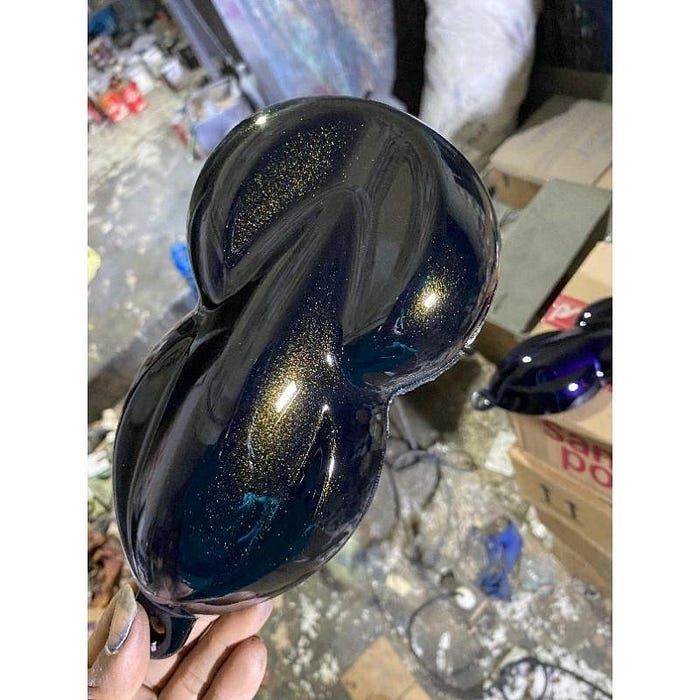
Cat Moonblack gold PU

  Cat Moonblack gold PU  adalah salah satu series yang mengandung partikel kecil seperti crystal yang dan memiliki effect lebih gelap sehing...